🍁 100% CANADIAN OWNED AND OPERATED

Visit us in REGINA and SASKATOON

STORE HOURS: Mon-Fri 8-4:30

Eva-Last decking in Saskatchewan — also written as Evalast or Eva Last

The Ultimate Deck Shop is the authorized Eva-Last dealer for Saskatchewan, with full Eva-Last decking inventory at our Saskatoon and Regina yards. Whether you spell it Eva-Last, Evalast, Eva Last, or Eva-last, we stock every tier — Infinity IS, Apex PLUS, and Pioneer — including the bamboo-infused composite boards rated for Prairie freeze-thaw cycles.

Looking for a deck shop in Saskatoon or Regina that carries Eva-Last decking? You're at it. We're the deck store Saskatoon homeowners and contractors come to first for composite decking, and we've been Regina's go-to deck shop for backyard building since 2016. Eva-Last decking, Trex decking, Fiberon, Deckorators — every major composite brand under one roof at TUDS.

Common search terms for this page: Eva-Last decking Saskatoon, Evalast decking Regina, Eva Last composite Saskatchewan, bamboo decking Canada, Eva-Last Apex PLUS price, Eva-Last Pioneer Saskatchewan, Eva-Last Infinity IS Prairie, deck shop Saskatoon, deck shop Regina, composite decking Saskatchewan, where to buy Eva-Last in Canada, Eva-Last dealer near me..

TUDS Comparison Guide

Composite vs PVC. Honest comparison.

Different chemistry. Different price. Different best-fit. We sell every major capped composite and capstocked PVC line in Canada — so we'll tell you exactly where each one wins, and where each one shouldn't be on your shortlist. No rankings. No trash-talk. Just the comparison you actually need before you spend $8,000+ on boards.

The five comparison axes

Composite vs PVC — what actually differs.

Five axes you should weigh before you choose. Chemistry, long-term performance, aesthetic range, cost, and which brands lead in each material. Read each — then jump to the comparison table or the calculator.

Cross-section comparison of capped composite decking and cellular PVC decking — showing the wood-fibre core of composite versus the all-polymer core of PVC
Axis 1 of 5 Tier
What it's actually made of

Chemistry

Capped composite has wood. Capstocked PVC doesn't. Everything else flows from there.

Capped composite = wood fibre (hardwood flour, bamboo, or recycled wood) + recycled plastic (HDPE or PVC) + a polymer capstock that surrounds the board. The wood content is what makes a composite a composite — it gives the board weight, dimensional stability, and a grain that prints naturally. Modern capped composites at TUDS run 30%–60% recycled wood with the rest being plastic and cap.

Capstocked PVC (often called "cellular PVC") = no wood at all. The core is foamed PVC for weight reduction, with a PVC or PMMA capstock fused on top. Because there's no organic substrate, there's nothing for mould or rot to attach to — and nothing to absorb moisture. That's the chemistry advantage that drives most of PVC's downstream durability claims.

One nuance: Eva-Last uses a bamboo-infused PVC composite — wood content is bamboo (regrows ~50× faster than hardwood) and the plastic is PVC, not HDPE. So Eva-Last sits between a traditional capped composite and a pure PVC board. It's still a composite (it has organic content) but the chemistry is closer to PVC than wood-flour composites are.

Composite core
Wood fibre + plastic
PVC core
100% PVC, no wood
Capstock
PVC or PMMA, both materials
Hybrid (Eva-Last)
Bamboo + PVC composite
Recyclability
Both recyclable
Bottom line
Different substrates, both viable
WADE
WADE · Co-owner, TUDS

“The wood-versus-no-wood distinction is the only one that actually matters at the chemistry level. Everything else — heat, scratch, fade — is downstream of what the cap is made of, not whether there's wood inside.”

Capped composite and cellular PVC decking installed under direct Prairie summer sun — comparing thermal behaviour, scratch resistance, fade, and mould
Axis 2 of 5 Tier
Heat · scratch · fade · mould

Long-term performance

PVC stays cooler and drier. Composite scratches less than people think. Both fade — but at different rates.

Heat retention. PVC runs measurably cooler than composite under direct sun — the lighter cell structure and the absence of a wood core means less thermal mass to absorb radiation. On a 30°C Saskatoon afternoon, a dark PVC board will read 5–10°C cooler than a same-colour capped composite. Lighter colours close the gap on both sides; the colour you choose matters more than the material.

Scratch resistance. PVC capstocks (and PMMA capstocks like the one on Eva-Last Pioneer) generally beat composite caps for scratch hardness — but every modern capped composite shipped at TUDS in 2026 is rated to handle dragged patio furniture and pet claws. Real-world scratch failure stories almost always trace back to first-gen uncapped composites from a decade ago, not anything we sell today.

Fade. All capped boards (composite and PVC) are warranted to fade no more than 5 ΔE units over the warranty period — that's a barely-perceptible shift to the human eye. Pioneer and high-end PVC carry 50-year fade warranties; mid-tier composite is typically 25–30. PVC is mathematically less likely to fade because UV chemistry on pure polymer is more stable than UV chemistry on a polymer-plus-organic composite — but at warranted thresholds, the difference is academic.

Mould + staining. This is where PVC has a real-world edge. No wood substrate = nothing for mould to grab. Capped composite is excellent (the cap is the barrier — mould can't reach the wood) but if the cap ever cracks at an end-cut or fastener, PVC gives mould nowhere to go even if breached. For pool decks, hot tub surrounds, and shaded north-facing yards, this matters.

Heat retention
PVC ~5-10°C cooler
Scratch resistance
PVC > Composite (slight)
Fade resistance
Both ≤5 ΔE warranted
Mould / staining
PVC clear winner
Cold-crack (Prairie)
Both rated; bamboo + PVC best
Best for shade
PVC — no organic substrate
SHANE
SHANE · Co-owner, TUDS

“If you have a pool, a hot tub, or a shaded yard that stays damp — PVC is the safer bet on the mould axis alone. If the deck is full sun and exposed, the colour you choose matters more than whether it's composite or PVC. Pick a lighter board either way.”

Capped composite versus PVC decking aesthetic comparison — composite leans wood-grain realism, PVC offers wider design range including monochromatic and exotic-hardwood photorealistic boards
Axis 3 of 5 Tier
What each leans toward

Aesthetic

Composite leans toward natural wood-grain. PVC has the wider colour and effect range — including the most photorealistic Ipé-look boards on the market.

Composite is what most people picture when they imagine "composite decking" — a wood-grain-printed cap over a wood-containing core. The grain reads natural because the underlying material has actual wood in it; the print works with the substrate, not against it. Mid-grain Brazilian teaks, weathered greys, classic cedars — composite owns the natural-wood-look category. The grain reads especially well in diffused light and shaded yards where shadow catches the texture.

PVC has historically leaned more uniform and "clean" — solid colours, monochromatic looks, the architectural-modern aesthetic. But the newest generation of PVC and PMMA-capped boards (think Eva-Last Pioneer, AZEK Vintage, Fiberon Sanctuary) use multi-tone photorealistic printing that mimics exotic hardwoods (Ipé, Garapa, Cumaru) better than any composite can. If you want "deck that looks like real Ipé" — that's PVC territory now.

Texture. Both come embossed or wire-brushed. Premium tiers in both categories add traction texturing for wet-deck grip — Apex PLUS (composite) and Pioneer (PVC) both ship with high-grip caps.

Composite leans
Natural wood-grain look
PVC leans
Wider range, exotic hardwood
Best wood-look
Composite (mid-grain)
Best Ipé-look
PVC (PMMA cap photoreal)
Monochromatic
PVC — cleaner solids
Pattern repeat
PVC photoreal has no repeat
WADE
WADE · Co-owner, TUDS

“The aesthetic argument used to be 'composite for wood-look, PVC for clean modern.' The new PMMA-capped PVC boards changed that — Pioneer and Sanctuary look more like real Ipé than any composite I've ever seen. If exotic hardwood realism is the goal, PVC is now the answer.”

Cost comparison of capped composite versus PVC decking per square foot installed in Canadian backyards — composite typically $5-$10 per board, PVC $7-$14 per board
Axis 4 of 5 Tier
Upfront vs lifetime

Cost

Composite is cheaper upfront. PVC is comparable to slightly cheaper over 30 years if you actually keep the deck that long.

Upfront, board only. Composite ranges roughly $5–$10 per board foot at retail in Canada (12-ft 5.5" boards). Capped PVC and PMMA-capped PVC ranges $7–$14 per board foot. On a 320 sq ft deck, that's a $1,000–$2,500 material delta between mid-tier composite and mid-tier PVC. The premium tiers in each material converge — Apex PLUS (premium composite) and Pioneer (luxury PVC) sit closer than their entry tiers do.

Installed. Add fasteners, framing, trim, and labour. Composite and PVC install nearly identically — same hidden-clip systems, same joist spacing rules, same expansion gapping. Labour is a wash. Total installed cost on a 320 sq ft deck in Saskatchewan: $14,000–$22,000 for composite, $16,000–$26,000 for PVC, depending on tier and trim.

Lifetime cost. Both materials are essentially maintenance-free — no staining, no sealing, no oiling. The only "carrying cost" is occasional cleaning. Both have warranties that cover the substantive failure modes for 25–50+ years. If you keep the deck the full warranty period, the per-year cost difference between composite and PVC is small. If you sell the house in 10 years, composite recovers more of its premium because the upfront difference is smaller.

The exception. If your build will see harsh chemical exposure (saltwater pool, coastal salt air, frequent chlorine splash), PVC's substrate is meaningfully better at resisting structural damage. The cost premium pays back faster in that scenario.

Composite range
$5-$10 / board
PVC range
$7-$14 / board
Install cost
Same for both
20-yr carrying
Both maintenance-free
Warranty span
Composite 25-50 yr · PVC 50+ yr
Resale upside
Composite recovers premium faster
SHANE
SHANE · Co-owner, TUDS

“The cost argument is overstated in the blog posts you'll read online. The real upfront delta on a 320 sq ft deck is usually under $2,000 between equivalent tiers — that's less than what people spend on a single piece of patio furniture. Pick the material that fits the yard, not the spreadsheet.”

Best capped composite and capstocked PVC decking brands available in Canada — Eva-Last, Trex, Fiberon, Deckorators, AZEK side by side
Axis 5 of 5 Tier
Where to actually shop

Right brand for each

If you've decided composite, here's the lineup. If you've decided PVC, here's the (smaller) lineup.

Best capped composite brands at TUDS:

  • Eva-Last Apex PLUS — bamboo-infused PVC composite. The flagship most TUDS customers choose; thermally stable, best-in-category grip, hyper-realistic grain, 50-year warranty.
  • Trex Transcend — recycled wood fibre + HDPE. Largest brand recognition in North America, deepest colour range (9 colours at TUDS), 25-50 year fade warranty.
  • Deckorators Voyage — mineral-based composite. Different chemistry (no wood flour at all in the core), exceptional dimensional stability, 50-year structural warranty.
  • Fiberon GoodLife — wood flour + HDPE. Solid value-tier capped composite for budget-conscious builds.

Best capstocked PVC / PMMA-capped lines at TUDS:

  • Fiberon Sanctuary — capstocked PVC with PVC cap. Cooler underfoot, mould-resistant by chemistry. Strong fit for shaded or pool-adjacent decks.
  • Eva-Last Pioneer — PMMA cap over foamed mineral-polymer core. Photorealistic exotic-hardwood print, 50-year warranty, the closest thing to real Ipé without the maintenance.

Brands TUDS doesn't carry but you may see online: AZEK / TimberTech (cellular PVC and capped composite — major US brands; we don't currently stock at retail). If AZEK is on your shortlist, drop into either store and we'll show you the equivalent line in our lineup at a similar tier.

Best composite (premium)
Eva-Last Apex PLUS
Best composite (range)
Trex Transcend
Best composite (mineral)
Deckorators Voyage
Best PVC (mid)
Fiberon Sanctuary
Best PVC (luxury)
Eva-Last Pioneer
Best PVC (Ipé-look)
Eva-Last Pioneer
WADE
WADE · Co-owner, TUDS

“The brand matters more than the material. A premium composite from a strong brand will outlast a mid-PVC from a brand without a track record. Start with which brand you trust, then pick the line within that brand that fits your yard. Both Eva-Last and Trex have honest 50-year tracks at TUDS — those are the safe starting points.”

2-minute decision quiz

Composite or PVC for your project?

Five questions on budget, climate, lifestyle, and time-horizon. One honest recommendation. No email required.

Question 1 of 5
0% complete

What's most important on your deck?

If you walked into TUDS

The three composite-vs-PVC questions we get every week — and what we'd actually say.

"Just tell me — is PVC actually worth the extra money?"
Shane · Co-owner
Shane · Co-owner

Honest answer: only if your specific deck environment exploits one of PVC's structural advantages. Pool deck, hot tub surround, north-facing shade, salt air — yes, PVC pays back. Standard south-facing backyard with adults, normal traffic, no pool? You'll be just as happy with Eva-Last Apex PLUS or Trex Transcend for ~$1,500–$2,500 less on a 320 sq ft deck. Either way you're getting a 50-year warranty and a deck that doesn't need staining. The PVC premium is a real-world payback only when the chemistry advantage matches your yard.

See PVC options
"What's the difference between capped composite and cellular PVC?"
Wade · Co-owner
Wade · Co-owner

Capped composite = wood-content core + polymer cap. The cap is the shield; the wood gives the board structure and natural grain. Examples: Trex Transcend, Eva-Last Apex PLUS, Deckorators Voyage. Cellular PVC = no wood at all. The core is foamed PVC (cells of air dispersed in PVC) for weight reduction; the cap is also PVC or PMMA. Examples: Fiberon Sanctuary, AZEK Vintage, Eva-Last Pioneer. Functionally: both feel similar underfoot, both install with the same hidden-clip systems, both warranty 25-50+ years. The cellular PVC will run cooler and resist mould better; the capped composite will look more like natural wood at the same price point.

See the comparison table
"Will composite or PVC handle Saskatchewan winters better?"
Shane · Co-owner
Shane · Co-owner

Both can — if you pick a quality brand. Cold-crack failure happens when the substrate absorbs moisture in the fall, freezes, and the expansion cracks the cap from underneath. PVC has zero organic substrate and zero moisture absorption — structurally the safest bet for Prairie freeze-thaw. Bamboo-content composites (Eva-Last) absorb less moisture than wood-flour composites and are the next safest. Wood-flour composites in the major brands we stock (Trex, Fiberon GoodLife) have all been Prairie-tested and we've never paid a cold-crack claim on them. So: PVC > bamboo composite > wood-flour composite, but all three are in the "safe for Saskatchewan" zone.

Read more on Prairie performance
Composite vs PVC · the comparison table

Eleven attributes. Both materials. No rankings.

Scope: Capped composite (wood fibre + plastic + cap) vs capstocked PVC (cellular PVC core + cap) vs bamboo-PVC hybrid (Eva-Last's chemistry sits between the two). Every attribute below references real specs from boards we stock at TUDS in Saskatoon and Regina. Live pricing reads from Shopify variants in the calculator.

Attribute Capped compositeCapstocked PVCBamboo-PVC hybridNotes
Material Wood fibre + recycled plastic + cap100% PVC, no woodBamboo + PVC + capEva-Last sits in the hybrid column
Heat retention Higher (varies by colour)Lower — cooler underfootLower than wood-flour composite~5-10°C delta on dark colours
Scratch resistance High (cap dependent)HighestHighPMMA caps lead the category
Fade Capstock-rated 25-50 yrCapstock-rated 50 yr+50 yr (Eva-Last Pioneer)All warranted ≤5 ΔE
Mould / staining Excellent cappedBest — no organic substrateExcellent — bamboo + PVCPVC wins for pool/shade/salt
Cost per board (12-ft) $5-$10$7-$14$5-$10Live pricing in calculator below
Warranty (residential) 25-50 year50 year+ (lifetime common)30-50 yearAll prorated in later years
Aesthetic Wood-grain leaningWider design range, photoreal IpéWood-grain + photoreal optionsPioneer = best Ipé look
Recyclability High — recycled wood + plasticModerate — PVC onlyHigh — bamboo regrowth + PVCBamboo regrows ~50× faster than hardwood
Cold-crack (Prairie) StrongStrongest — no moisture absorptionStrong — bamboo absorbs lessTUDS has paid no claims on any
Best for Most projects, value, wood lookPool decks, hot climates, premiumHybrid — versatile across bothMatch material to yard, not spreadsheet
Deep dive: Eva-Last vs Trex for Canadian backyards
Live deck cost calculator

Price composite and PVC side by side.

Width × length for rectangles. Total square-feet for anything else. See exactly what stepping from composite to PVC costs on your deck size.

100 ft² 1,000 ft² 2,000 ft²
Area priced
320sq ft

Material only. Framing, fasteners, railing, and labour quoted separately. Get an instant estimate for a real number on your whole project.

Eva-Last Infinity IS
Composite Entry
approximate · boards only
Eva-Last Pioneer
PVC Luxury
approximate · boards only
Same fasteners. Same finishes.

Composite or PVC, complete the build.

Hidden fasteners that work on both materials, cut-end paint colour-matched to either category, and our house-brand cleaner that's safe on every cap.

Clips de bord camouflageHidden fastener

Camo Edge Clips

Universal hidden-clip system — works on every grooved capped composite and grooved capstocked PVC board we stock.

$54.19 starting
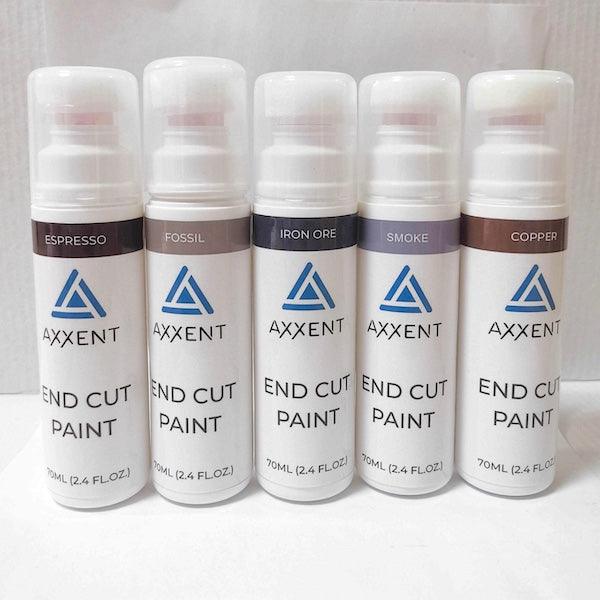
Peinture de coupe d'extrémité AxxentBoard-end finish

Axxent End-Cut Paint

Seals the cut ends of composite boards so the lighter core doesn't show. Eight colour shades — match to your tier colour.

$24.99
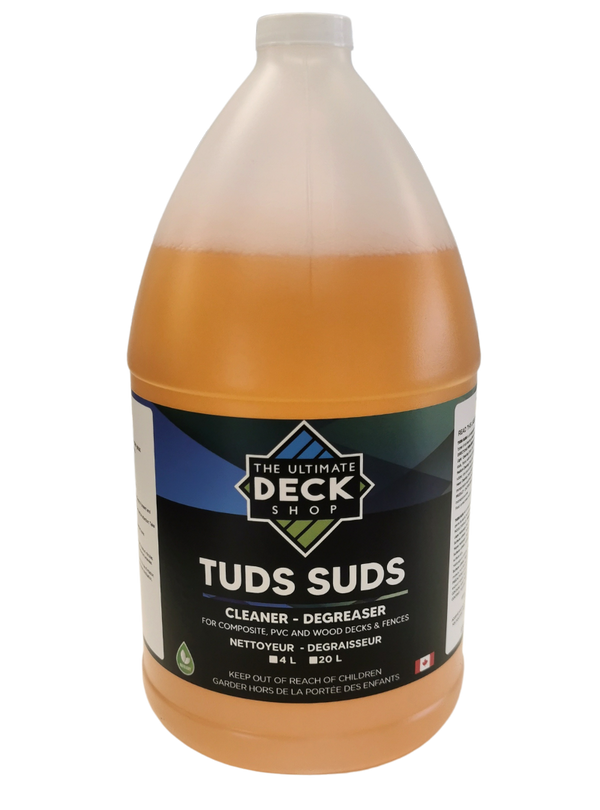
TUDS SUDS Deck CleanerCleaner

TUDS SUDS Deck Cleaner

Our house-brand cleaner, formulated for composite + wood decks. Non-caustic, non-butyl, eco-friendly.

$29.99
Composite vs PVC FAQ

The questions everyone asks — before they decide.

Don't see yours? Call either store and one of our Escape Artists will help.

Not categorically — it's better at specific things. PVC is cooler underfoot in direct sun, more mould-resistant (no organic substrate), and the most scratch-hard caps in the category are typically PMMA-on-PVC. Composite is cheaper upfront, leans more natural-wood-look in grain, and uses fewer raw plastic resources. For pool decks, hot tub surrounds, and shaded yards, PVC's chemistry advantages turn into real-world durability. For a standard south-facing backyard with normal traffic, capped composite gives you 90% of the PVC outcome at 70-80% of the price. Both materials at TUDS carry 25-50+ year warranties.

Capped composite has a wood-content core (recycled wood flour, bamboo, or hardwood fibre mixed with HDPE or PVC plastic) wrapped in a polymer capstock. Cellular PVC has no wood at all — the core is foamed PVC (PVC with dispersed air cells for weight reduction) wrapped in a PVC or PMMA capstock. Functionally both install identically with the same hidden-clip systems and the same joist spacing. The capped composite gives you a more natural wood-grain look; the cellular PVC gives you a cooler-running, mould-proof board with stronger scratch resistance. Examples of capped composite: Trex Transcend, Eva-Last Apex PLUS. Examples of cellular PVC at TUDS: Fiberon Sanctuary, Eva-Last Pioneer.

Yes — by roughly 5–10°C on a same-colour comparison in direct summer sun. The wood content in composite gives the board more thermal mass, which absorbs and retains more solar radiation than the foamed cellular core of PVC. That said, the colour you choose matters more than the material. A light grey composite will run cooler than a dark espresso PVC. For full-sun south-facing decks where bare-feet barbecues are non-negotiable, choose PVC and a lighter colour to stack both effects. For shaded yards, the heat differential is largely irrelevant.

On warranty paper, PVC carries the longer headline numbers — 50-year, lifetime, and 25-year fade warranties are common on premium PVC lines. Premium capped composite typically warranties 25-50 years residential. In practice, both modern capped boards (composite and PVC) outlast most homeowners' patience for the deck design itself — a properly installed deck of either material in 2026 is engineered for 30+ years before any visible degradation. The longer-lasting material in any given yard is the one whose chemistry matches the environment: PVC for pool decks and shade, composite for standard backyard sun. Full breakdown in the comparison table above.

Worth it when one of these is true: your deck has continuous chemical or moisture exposure (pool, hot tub, salt-air), your yard is permanently shaded (north-facing, mature tree canopy), you want the most photorealistic exotic-hardwood look currently available (PMMA-cap PVC like Eva-Last Pioneer beats every capped composite for Ipé realism), or the deck must be cooler underfoot for kids and pets in full sun. Not worth the premium when: you have a standard south-facing backyard with normal traffic and you're choosing a wood-grain colour. In that case the $1,500-$2,500 saved on a 320 sq ft project covers the railing or buys you better fasteners.

Sometimes — but increasingly, no. Older PVC boards were obvious: monochromatic, plasticky-looking, uniform sheen. Modern PMMA-capped PVC (Eva-Last Pioneer, AZEK Vintage) uses multi-tone photorealistic printing that beats most capped composites for hardwood realism. The only reliable test is to lift the board: PVC is noticeably lighter than capped composite of the same dimensions because the core is foamed. Capped composite has the heft of wood; PVC has the heft of dense plastic. Walk the swatch wall at either TUDS showroom and you'll feel the difference in 30 seconds.

Both modern capped boards are rated for normal residential traffic — patio furniture dragged across them, dog claws, bicycle tires, BBQ-tool drops. PMMA-capped PVC (Pioneer-tier) carries the highest cap hardness in the category and is the most resistant to micro-scratches that show in raking light. Standard PVC capstocks and premium composite capstocks (Apex PLUS, Trex Transcend) sit at similar real-world performance. Where both materials struggle: dragged metal furniture legs, dropped grill grates, ash from a fire pit on a hot board. Use felt pads, lift-don't-drag, and keep open flame off any deck surface. Both will outperform pressure-treated and most softwood options on every scratch axis.

PVC has a structural advantage on paper: zero wood content means zero moisture absorption, which means zero risk of freeze-thaw cold-crack failure. That said, every modern capped composite TUDS stocks has been Prairie-tested through -42°C cold cycles, and we've never paid a cold-crack warranty claim on any line we've sold. Eva-Last's bamboo-PVC hybrid sits closest to PVC on the cold-crack chart because bamboo absorbs less moisture than wood flour. Trex and Fiberon both perform reliably on Prairie installs. Bottom line: pick from a quality brand and you're safe in any Saskatchewan winter — PVC is just incrementally safer, not dramatically.

Yes — but only as visible feature elements, not as the main field. Mixing different boards in the deck surface itself runs into expansion-coefficient mismatches: composite and PVC expand at slightly different rates with temperature, which over time can cause uneven gaps or surface tension at the seams. Where mixing works: PVC for pool-edge or stair-tread boards (where the chemistry advantage matters most) with capped composite for the broader field, or PVC fascia and trim around a composite surface. If you're considering a hybrid build, talk to one of our Escape Artists at either showroom — we'll work through the expansion math with you and spec the right gapping.

From TUDS

More on composite + PVC. From our team.

Deeper dives, video walk-throughs, podcast episodes, and brand-by-brand comparisons. We make a lot of content because the questions never stop.

Latest from TUDS · YouTube

Watch the latest from TUDS

Unboxings, install walkthroughs, brand comparisons. New video most weeks — the player above always shows our latest.

Subscribe on YouTube →
The TUDS Podcast

The Deckheads

Honest talk about real projects, real mistakes, and Prairie deck-building. Long-form, for homeowners and pros alike.

Follow along — daily builds, honest takes.
Why TUDS

The numbers nobody else in the prairies can match.

Real Google reviews from real Saskatoon and Regina customers — across composite and PVC builds.

2016
Canadian-owned since
2
Stores — Regina & Saskatoon
90+
Authorized brands
10,000+
Customers helped
4.9
TUDS Google rating
★★★★★
GGoogle

“We recently gave our 20 year old wood deck a makeover with the help of The Ultimate Deck Shop. Justin at the Regina location was incredibly helpful with each of my visits, answering my questions and explaining/showing me things clearly. To refinish the top of the deck, we used Cutek Wood Reviver followed by Cutek Ex...”

Nicole N.
Regina · Jul 2025
★★★★★
GGoogle

“We had a great experience with The Ultimate Deck Shop. The fence we purchased is great quality. The service was amazing. The price was the best around. We would highly recommend to anyone and will definitely refer family and friends.”

Denise A.
Regina · Nov 2025
★★★★★
GGoogle

“Amazing service (Sam was super helpful and patient). Beautiful options, all staff were friendly. Highly recommend.”

Nikki H.
Regina · Jul 2025
Come see both materials side by side

Composite, PVC, and every brand on one showroom floor.

Two yards. Every major composite + PVC line in stock. Walk both materials, lay them in the same light, lift each one to feel the weight — the comparison reads in five minutes in person what takes weeks online.

Store

Regina

141 4th Avenue East, Regina SK

Every major capped composite + capstocked PVC line on the wall — Eva-Last, Trex, Fiberon, Deckorators, side by side. Lay them against your siding before you spend $14k+.

Mon–Fri 7am–5pm · Sat 9am–3pm

Store

Saskatoon

320 68th Street East, Saskatoon SK

Composite and PVC samples in the same showroom. Walk the boards, hold them in raking light, lift one of each — feel the weight difference. Five minutes here saves five months of online comparison-shopping.

Mon–Fri 7am–5pm · Sat 9am–3pm

Delivery service area · Composite + PVC in stock
SaskatoonReginaMoose JawPrince AlbertYorktonLumsdenWarmanMartensvilleSwift CurrentNorth BattlefordWeyburnEstevanHumboldtCalgaryEdmontonWinnipeg+ Most of SK, AB, MB
We deliver across Saskatchewan and into Alberta and Manitoba. Call either yard for a freight quote on your address and material choice.
Your Backyard Building Centre

Composite or PVC. Either way, we'll help you choose right.

Canadian-owned, Prairie-stocked. Every major capped composite and capstocked PVC brand on one showroom floor. Get an honest instant estimate, or come walk every board in Saskatoon or Regina before you spend a dollar.